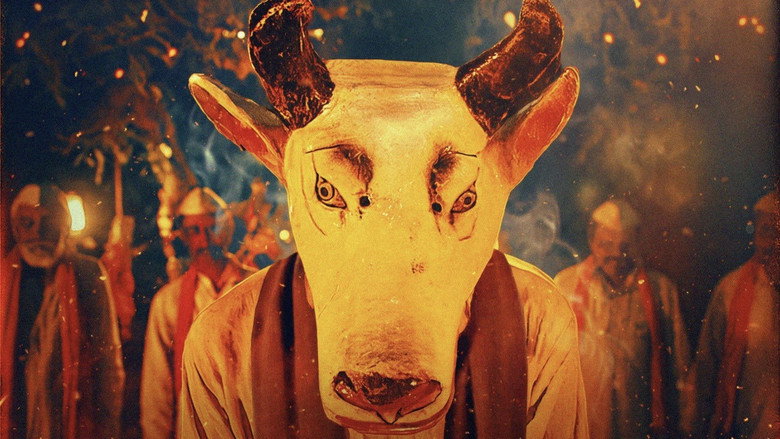
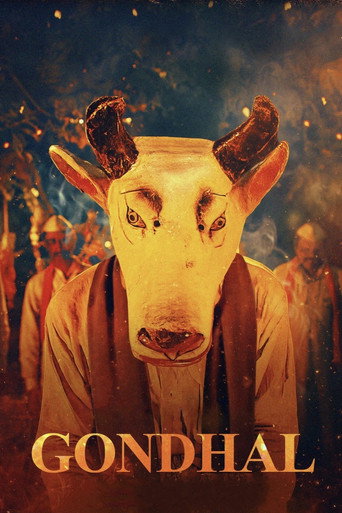
Suman, a newly-wedded wife in Maharashtra's Gondhal rituals, conspires with Gondhali Saheba to kill her husband, Anand. They plan to carry out an escape that jeopardises her soul amid drum-driven ritual and divine omens, blurring the distinction between salvation and damnation in a citywide verdict of fire, blood, and awe.
**Gondhal \[2025\]**
**The Plot:**
Bhivaba, a respected and financially well-off Gondhali, sets out to perform a Gondhal at the house of a Patil family. He is accompanied by his grandson, Vishnu, and his fellow performers. As they walk through the dark village night with a lantern, they discuss the disappearance of Bhivaba’s son, which is being investigated by the police. The disappearance is connected to Sarjerao, a member of another branch of the Patil family, and his father, Abasaheb, the elder Patil. The father and son use fear and violence to maintain their control over the village and display their power.
At the Patil house where Bhivaba is going to perform, Suman has recently married Ananda. Sarjerao is deeply in love with Suman, while Suman seems attracted to him because she dreams of becoming a Patlinbai. Although she is married to Ananda, she continues to respond to Sarjerao’s feelings. During the Gondhal ceremony, Sahebrao, the man Suman truly loves, arrives in the village disguised as a Murali to perform in the same Gondhal. His presence creates a complicated relationship between Suman, Sarjerao, and Ananda. Suman wishes to leave Ananda and begin a new life with Sahebrao. To achieve this, Suman takes advantage of Sarjerao’s love and jealousy and convinces him to murder Ananda.
She plans for Sarjerao to be blamed for the crime and sent to prison, after which she intends to escape with Sahebrao. As the Gondhal continues through the night, the hidden relationships and the murder plan lead to a series of violent events. As planned by Suman, Sahebrao halts a Gondhal ritual and directs Ananda to a river nearby telling him that it is the deity's calling to perform a new ritual on the bank of the river. Everyone present there believes Sahebrao should perform the ritual as it is a Gondhali suggesting the new ritual. In the meantime, Sarjerao kills his Aabasaheb in the backyard for always being against his and Suman's union and wears his father's turban implying that he has taken over the reign as the next Patil. However, Bhivaba attacks him from behind mistaking him to be the Patil and ends up killing Sarjerao. Unable to find Sarjerao to send at the river bank to kill Ananda, Suman now passes on the responsibility to Sahebrao to go and kill him for the sake of their love.
A hesitant Sahebrao goes to the river bank and calls out for him, where he is attacked by Ananda, leading to a gruesome fight in the water. It is later that Ananda had learnt about the conspiracy against him and it was him who attacked Sahebrao which ended in Sahebrao's death. The film ends with Ananda surviving the night, while Sahebrao and Sarjerao are dead. The Gondhal ceremony concludes at dawn, contrasting with the violence, betrayal, and power struggles that have taken place during the night.
**Movie Review:**
Gondhal was a Marathi film that was released on 14th November 2025. This was a film that would not have been in my watchlist, however because the film was India’s official submission to the Oscar, I became curious and watched it yesterday in INOX Mantri Square Sampige Road Malleshwaram, Bangalore.
I disliked the story because I feel it is too morally dark for my taste. The human emotions are present but it did not connect with me because of its morally dark nature. There are few central characters who are driving the story of Gondhal.
I would divide Gondhal’s narrative structure into eight phases:
i). First: Exposition: Bhivaba, Vishnu and the performers travel through the village at night. The disappearance of Bhivaba's son is introduced, alongside the oppressive authority exercised by Abasaheb and Sarjerao.
ii). Second: Establishment of the romantic and marital conflicts: Suman's marriage to Ananda, Sarjerao's attraction to Suman, and Suman's ambitions of becoming a Patlinbai establish the interpersonal tensions.
iii). Third: Sahebrao’s arrival: Sahebrao arrives disguised as a Murali. His relationship with Suman reveals that her actual romantic objective is neither Ananda nor Sarjerao.
iv). Fourth: The conspiracy: Suman manipulates Sarjerao into agreeing to murder Ananda, intending to have Sarjerao imprisoned and then escape with Sahebrao. Sahebrao interrupts the Gondhal and sends Ananda to the river under a religious pretext.
v). Fifth: The first violent reversal: Sarjerao kills his father for opposing his desired union with Suman. He subsequently wears Abasaheb's turban, symbolically assuming the position of the next Patil.
vi). Sixth: The second violent reversal: Bhivaba mistakes Sarjerao for the elder Patil and kills him. Suman's original plan collapses because the man designated to murder Ananda is himself dead.
vii). Seventh: The climax: Suman directs Sahebrao to murder Ananda. However, Ananda has discovered the conspiracy and attacks Sahebrao, leading to a brutal struggle in the water that ends with Sahebrao's death.
viii). Eighth: Denouement: Ananda survives, while Sarjerao and Sahebrao are dead. The religious ceremony concludes as daylight arrives, providing a contrast between devotional observance and the night's violence.
In my assessment, the story is not deeply and profoundly layered. It operates within the boundaries of neorealistic films. The narrative developments are killing and survival in the 2nd half which is morally dark for me.
The screenplay managed to sustain my interest especially in the 1st half. The director begins the film with a single long sequence that travels from the woods at night, past the village festivities and into Suman's room, introducing the principal characters and the geography of the village along the way.
In my assessment, the screenplay of the film is slow-paced because in its 120 minute duration there are less narrative developments. But within the context of this film, the slow pacing does not become a drawback as that is the hallmark of neorealistic films in my opinion.
Neorealistic films work well for me when its atmosphere works for me. Before interval, that was going well for me, but when the killings start, it became unpleasant for me.
The only thing I liked throughout the film is the background score that was composed by Illaiyaraaja, which I felt was really very good.
There is one more significant complaint, which is not related to the film but it is worth mentioning because it did affect me in my viewing experience. The INOX Mantri Square theater gave less brightness due to which the faces of actors were not visible. This caused me severe irritation on a film that had a morally dark story.
This is not inherently a film’s weakness, but it affects us because:
i). When I am unable to see the faces of actors, it becomes difficult for me to evaluate acting performances. How on earth I am going to evaluate the facial expressions.
ii). I have serious distaste towards the stories that are morally dark and there is no guilt about it. On top of it when faces are not visible due to negligible theater management, the irritation becomes even more and that is exactly what happened with me.
Gondhal did not deliver the emotional payoff for me, and the film’s reliance on constant killings made me feel disturbed, and one of the killing is coincidental even though such conspiracies may happen in reality and also because the film has plenty of scenes where villagers are shown celebrating the ritual which is why I classified this film as neorealistic film. However, the film can also be described or classified as conspiracy-driven rural drama film with neorealistic shades. Probably this description is better.
Overall, Gondhal despite not delivering the final emotional payoff for me, it did not become a time or money waste as my main purpose was craft evaluation, which got fulfilled. However in my opinion, the film fails in its craft because even within the boundaries of neorealistic criterias I was evaluating on, the film fell short hence I classify this film as a poorly crafted movie.
My Rating: ⭐½☆☆☆
My Verdict: Bad